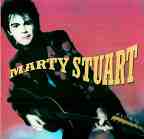
 |
Marty Stuart |
|
Marty Stuart |
 |
All Music Guide | |
Music City News | |||||||||
|
Billboard | |
My Kind Of Country | |||||||||
|
Country Music | |
New Country |
All Music Guide |
|
|
A former bluegrass picker and Johnny Cash sideman, Stuart burst on the scene with this largely rockabilly-flavored album. Not a great album, but made somewhat more interesting by some of the people appearing on the record and the inclusion of two Steve Forbert songs. By Jim Worbois Rated: 5 |
|
Billboard |
July 12, 1986 |
| A strikingly good major-label debut by an act with great potential in country music and beyond. The first single, "Arlene," has already broken the country top 20; with energetic promotion, it and others could find homes on Adult Contemporary and college playlists. | |
Country Music |
September/October 1986 |
| I don't think it's coincidence that four of today's most interesting new country artists started out as bluegrass child prodigies--Ricky Skaggs, Keith Whitley, Mark O'Connor and now Marty Stuart. Bill Monroe himself has talked of how playing bluegrass gives a performer uncommon strength and depth. This strength manifests itself in differing ways. Skaggs wears his bluegrass roots on his sleeve, consciously sticking to traditional music and values. Marty's music is looser and more raucous; tradition plays a more subtle part.
Working with Lester Flatt, then with Johnny Cash, as Marty did over the past decade, you learn the importance of being true to yourself. The result on this first album, for which both Stuart and producer Curtis Allen share credit, is a nearly flawless synthesis of rockabilly, bluegrass--two forms more closely related than many realize--1960's rock, blues and various contemporary pop styles that succeeds despite being a bit slick at times. The churning rockabilly of "Arlene," also released as Marty's first sing, leads off Side One. His revival of The Band's 1970 rocker, "The Shape I'm In"--with Duane Eddy guesting on guitar--is flashier, less rustic and cockier than the original. David Mallett's "Hometown Heroes" is a timeless and intriguing anthem-plus-warning of the ultimate futility of life in the small town fast lane. Two Steve Forbert compositions are among the most successful cuts on the album. "All Because of You" is a love song devoid of sugar-sweet sentiment, and "Honky Tonker," with its unrelenting Bo Diddly/bluegrass beat, breathes new blood into a theme that has been wearing thin for years. "Do You Really Want My Lovin," which Marty co-wrote with the late Steve Goodman, is a 1950's rhythm and blues roadhouse shuffle arranged Delbert McClinton style. "Maria," co-written by Marty and Curtis Allen, is a modern cowboy/bluegrass that evokes the spirit of Marty Robbins. My sole complaint--and this is directed at CBS--is the album's brevity, only eight songs. [Note: The CD reissued in 1992 contained 9 songs.] The "mini-album" approach may have it's place and they are priced proportionately lower than the standard ten-song albums, but any debut should give an artist the chance to stretch out to the max. I fail to see the advantage of abbreviation given Marty's clear ability to sustain himself. To introduce a new artist, I would argue that it would be money well spent for record companies to offer the customer more songs, not fewer. There will be those who will complain that none of this music is country, just as people complained that Bob Wills, Elvis and even Waylon were too far off the beaten path. Like those three, Marty's music has exciting new dimensions, many of them non-traditional considering Nashville's past direction. After years of watching Music Row--and millions of record buyers--choke on a steady diet of creamy pop mediocrity, maybe that's exactly what we need. By Rich Kienzle |
|
My Kind Of Country |
May 9, 2012 |
|
Marty’s mainstream debut, on Columbia in 1986, was an inauspicious one. Originally released as a budget-priced eight-track “mini-album” (increased to none when the CD version came out in 1992), none of the songs is particularly memorable, Marty’s vocals were not very distinctive, and the production, courtesy of Curtis Allen, is largely dated country rock. His debut single was the rockabilly "Arlene," written by Allen, which featured Vince Gill on electric guitar. It crept into the top 20 and is quite entertaining, and similar to the music Steve Earle was making at that time. This promising start turned out to be Marty’s biggest hit on Columbia. The rockier "Honky Tonker," written by folk rocker Steve Forbert, then flopped – unsurprisingly in my opinion as it is boring and yelly. The mid-tempo "All Because Of You" is a mid-tempo love song also from Forbert’s pen which is a bit better. It crept into the top 40, but it is lyrically very repetitive and the instrumentation and production now sound very dated (and very pop). There is a guitar cameo by rock guitar legend Duane Eddy. Final single "Do You Really Want My Lovin’ " was another chart failure, although it is quite a catchy mid-tempo country rocker. It is one of three tunes co-written by Marty, in this case with Steve Goodman. The blaring saxophone sounds a bit out of place but the track is otherwise enjoyable, and I wonder if it might have done a little better if it had immediately followed "Arlene" while Marty had some momentum. Marty’s other co-writes here were with his producer Curtis Allen. "Heart Of Stone" is another pretty good country-rock number, which sounds like a slightly over-produced version of something the Desert Rose Band might have recorded, and has Kathie Baillie (of Baillie & The Boys) on harmonies. "Maria (Love To See You Again)" is a pleasant sounding Western themed ballad and story song, with one of the more country-styled productions on the record, with Marty playing mandolin for the only time on the album as a well as electric guitar, but the vocals are uninspired. It is also one of only two tracks to feature a fiddle, the other being the song added to the CD reissue. This is the slow "Beyond The Great Divide," written by Jack Wesley Routh and J C Crowley, and it features the instantly recognisable harmonies of Emmylou Harris. I don’t know if it was recorded at the sessions for this album and rejected, or if it was intended for the follow-up which never materialized. In contrast, Marty’s cover of The Band’s "The Shape I’m In" is too far in the rock direction for me. "Hometown Heroes" is a fine song written by David Mallett, and it is one of the better tracks although the production is uninspired and the tune strains Marty’s voice beyond its limits. The interesting song deals with the wild side of life in a small town and the tragedy of a wannabe rebel who ends up dying young. Overall there seems to be a lack of artistic identity with Marty not sounding as though he really knew what kind of music he wanted to make and trying out various personae. In the liner notes for his new album, he talks about this period of his career, saying he “tried to play country music, but it felt like rock & roll”, and that is rather what it sounds like. He was lucky to get another chance, but luckily he was to prove he was worthy of one. The CD is available, but not particularly cheaply. Grade: C By Occasional Hope |
|
Music City News |
August 1986 |
| As the first of CBS' six Horizon '86 artists to release product, Marty Stuart has something to be proud about here. This album exudes more energy and enthusiasm than what has been heard for a long time. For the past few years, Stuart has been a sideman for father-in-law Johnny Cash but shows us here he can break new ground.
Stuart has long been noted for his instrumental skills (he plays some superb electric guitar and mandolin riffs here), but he also has a strong voice that reflects credible interpretation through great phrasing and dynamics. Stuart also contributed three co-written songs on Side Two and they show the contracts of his musical styling. One, Maria (Love To See You Again), is a touchstone to his years as a bluegrass musician. Heart Of Stone offers bold vocals and strong layering of keyboards. His first single release, Arlene was a blast of rockabilly. These elements all blend together well under the producership of Curtis Allen. Hands down the best cut is the rollicking Honker Tonker, on which Stuart pulls out all the stops. Needless to say, I'm impressed. By Dixon Harden |
|
New Country |
April 1994 |
| "Arlene" was the most dangerous thing rolling out of car stereo speakers in the late '80s. Smoking guitar, gruff voice and a beat that thundered down on you. It was menacing and lusty--and probably scared radio off. A shame since "Flight of the Bumble Bee," "The Shape I'm In" and "Honky Tonker" was the best poo-poo platter of hillbilly music going. [Three Stars] | |
| Return To Album Reviews | Return To Home Page |